


Skills in Demand Visa (Subclass 482)
The Skills in Demand (Subclass 482) visa allows Australian businesses to sponsor suitably skilled overseas workers to fill positions where they are unable to find an appropriately skilled Australian worker.
Whether you are an employer looking to fill a skills shortage or you have been offered sponsorship by an Australian business, the Subclass 482 visa may provide a pathway to live and work in Australia.
Employer-sponsored visas involve more than simply lodging an application. Employers need to meet the sponsorship and nomination requirements, while visa applicants must satisfy the relevant visa criteria. Taking the time to get things right from the outset can help avoid unnecessary delays and make the process much smoother.
At Smart Australian Visas, we work with both employers and skilled workers, providing practical advice and assistance throughout the sponsorship, nomination and visa application process.
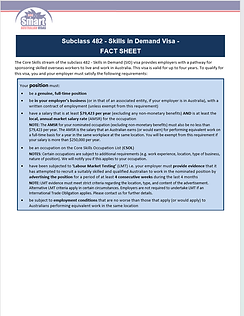

What is the Skills in Demand (Subclass 482) visa?
The Skills in Demand visa replaced the former Temporary Skill Shortage visa on 7 December 2024. While it remains a Subclass 482 visa, a number of important changes were introduced as part of the new employer-sponsored visa program.
The visa operates through three streams, depending on the position being offered, the proposed salary and the employer’s circumstances.
Core Skills stream
The Core Skills stream is the pathway used for most Skills in Demand (Subclass 482) applications.
The nominated occupation must be included on the Core Skills Occupation List. Some occupations also have additional requirements relating to matters such as the type of business, the location of the position or the nature of the work being performed, so appearing on the list does not always mean the occupation will be suitable in every case.
For nominations lodged between 1 July 2026 and 30 June 2027, the Core Skills Income Threshold is $79,423. The proposed salary must meet this threshold and must also be consistent with the Annual Market Salary Rate for the position.
The Annual Market Salary Rate is the amount an equivalent Australian worker earns, or would earn, for performing the same work in the same workplace and location. This means that offering a salary above $79,423 will not necessarily be enough if the usual Australian market rate for the position is higher.
Employers proposing to pay at least $250,000 may be exempt from the usual requirement to demonstrate the Annual Market Salary Rate.
The position must generally be within the sponsoring employer’s business, or an associated entity where permitted, and supported by a written employment contract unless an exemption applies. Different arrangements may apply to certain occupations, including some medical and senior executive roles.
When assessing whether the Core Skills stream is suitable, the occupation, position duties, salary and business circumstances all need to be considered together.
Specialist Skills stream
The Specialist Skills stream is available for certain highly skilled positions where the proposed salary meets the Specialist Skills Income Threshold.
The occupation does not need to appear on the Core Skills Occupation List. However, it must fall within ANZSCO Major Group 1, 2, 4, 5 or 6. These groups broadly cover managers, professionals, community and personal service workers, clerical and administrative workers, and sales workers.
Occupations classified in Major Groups 3, 7 and 8 are not eligible under this stream. This includes technicians and trades workers, machinery operators and drivers, and labourers.
For nominations lodged between 1 July 2026 and 30 June 2027, the Specialist Skills Income Threshold is $146,576. The proposed salary and the Annual Market Salary Rate for the position must generally both be at least this amount, excluding non-monetary benefits.
As with the Core Skills stream, the Annual Market Salary Rate is based on what an equivalent Australian worker earns, or would earn, for performing the same work in the same workplace and location. Employers proposing to pay at least $250,000 may be exempt from the usual requirement to demonstrate the market salary rate.
Some occupations and positions are subject to additional requirements or exclusions. For that reason, the occupation, duties and proposed salary should be reviewed carefully before the nomination process begins.
Labour Agreement stream
Some employers are able to sponsor overseas workers under a Labour Agreement negotiated with the Australian Government.
These agreements may be specific to an individual business or apply across a particular industry or region. They can provide alternative sponsorship arrangements where the standard visa requirements do not adequately address the employer’s workforce needs.
If you are unsure which stream applies to your situation, we can assess the position, proposed salary and business circumstances before you commit to the sponsorship process.
Understanding the Subclass 482 process
Most Skills in Demand (Subclass 482) applications involve three separate stages. Although they are often prepared at the same time, each stage has its own requirements and is assessed separately.
Step 1: Standard Business Sponsorship
If the business does not already hold a current Standard Business Sponsorship, the first step is usually to become an approved Standard Business Sponsor.
To be approved, the business must generally be actively and lawfully operating and satisfy the relevant sponsorship requirements. Once approved, a Standard Business Sponsorship is usually valid for five years, allowing the business to nominate eligible overseas workers during that period.
Approval also comes with ongoing responsibilities. Sponsors must comply with a range of obligations, including keeping certain records, notifying the Department of relevant changes and ensuring sponsored workers receive the required employment conditions.
Sponsors must not ask a sponsored worker to pay or reimburse costs that the employer is legally responsible for, including the Skilling Australians Fund levy and certain sponsorship, nomination and recruitment costs.
If the business already holds a current Standard Business Sponsorship, it may not need to complete this step again.
Some established businesses may also qualify for accredited sponsorship. Accredited sponsors receive priority processing for eligible Subclass 482 nomination and visa applications.
Step 2: Nomination
Once the employer is eligible to sponsor workers, the next step is to nominate the position it wishes to fill.
This is often the most important part of the process. The Department is not simply assessing whether an occupation appears on a list. It will also consider whether the position is genuine, whether the duties align with the nominated occupation and whether the business has a genuine need for the role.
Other important considerations include whether:
-
the proposed salary meets both the relevant income threshold and the Annual Market Salary Rate;
-
labour market testing has been completed correctly, where required;
-
the position is full-time;
-
the terms and conditions of employment are appropriate; and
-
the required Skilling Australians Fund levy has been paid.
The Skilling Australians Fund levy is paid when the nomination is lodged. The amount payable depends on the business’s annual turnover and the proposed period of the nomination.
Other costs may include the sponsorship, nomination and visa application charges, as well as expenses associated with skills assessments, health examinations, police clearances and professional assistance. The amounts will depend on the applications required and the circumstances of the employer and visa applicant.
A strong nomination involves much more than completing the application forms. The position description, employment contract, organisational structure, recruitment evidence, salary information and supporting business documents should all work together to present a clear and consistent picture of the position.
The documents required will depend on the business and position, but employers are commonly asked to provide business and financial records, an organisational chart, a detailed position description, an employment contract, labour market testing evidence and information supporting the proposed salary.
Step 3: Skills in Demand visa application
The final stage is the visa application, which is lodged by the proposed employee.
Depending on the occupation and the applicant’s circumstances, they may need to demonstrate that they have the required skills and experience, meet the English language requirements, satisfy any applicable skills-assessment and licensing requirements, hold appropriate health insurance and meet the relevant health and character criteria.
Although the nomination and visa application can often be prepared and lodged together, they are assessed separately. Both applications therefore need to satisfy their respective requirements before the visa can be granted.
Labour market testing
For most Subclass 482 nominations, employers are required to advertise the position before the nomination can be lodged. This is known as labour market testing.
The advertising must meet specific requirements relating to where and how the position is advertised, the information included in the advertisements and when the recruitment is undertaken. Unless an exemption or alternative requirement applies, the position will generally need to be advertised in at least two places during the four months before the nomination is lodged, with applications or expressions of interest accepted for at least four consecutive weeks.
Labour market testing is one of the areas where we most commonly see employers run into difficulties. Something as simple as advertising on the wrong platform, removing the advertisement too early or failing to keep the right evidence can create unnecessary issues when the nomination is lodged.
For that reason, we recommend obtaining advice before the advertisements are published rather than trying to fix a problem once the recruitment period has finished.
We can review your proposed job advertisements before they go live, advise whether they meet the standard requirements and explain what evidence should be retained for the nomination.
Salary requirements
One of the most common misconceptions about the Subclass 482 visa is that paying above the relevant income threshold automatically satisfies the salary requirements. However, it is not quite that simple.
In addition to meeting the applicable income threshold, employers generally need to demonstrate that the proposed salary is consistent with what an Australian worker would be paid to perform the same role in the same location. This is known as the Annual Market Salary Rate.
Depending on the circumstances, evidence may include:
-
the salary paid to an equivalent Australian employee performing the same role;
-
a relevant industrial award or enterprise agreement;
-
current job advertisements for comparable positions;
-
salary surveys or remuneration guides;
-
industry-specific salary information; or
-
other reliable labour market evidence.
The Department will also consider whether the sponsored worker will receive terms and conditions of employment that are no less favourable than those provided to an equivalent Australian worker.
Preparing appropriate salary evidence is often one of the more technical aspects of a nomination. We regularly assist employers with assessing the Annual Market Salary Rate and identifying the evidence needed to support the proposed salary before the application is lodged.
Who can sponsor an overseas worker?
Many Australian businesses may be eligible to sponsor an overseas worker under the Skills in Demand (Subclass 482) visa program. The business does not need to be large or have sponsored workers before, but it must satisfy a number of sponsorship and nomination requirements.
In most cases, the business will need to demonstrate that it:
-
is actively and lawfully operating in Australia;
-
has a genuine full-time position available;
-
has tested the Australian labour market where required and can demonstrate that the position cannot readily be filled by a suitably qualified and experienced Australian worker;
-
can meet the relevant salary and employment requirements;
-
can demonstrate that it is able to support the nominated position and meet the proposed salary and employment commitments;
-
has no relevant adverse information that may affect its suitability as a sponsor;
-
satisfies the applicable sponsorship and nomination requirements; and
-
will comply with its ongoing sponsorship obligations.
New, small and recently established businesses are not automatically excluded from sponsoring overseas workers. However, because they generally have a shorter trading history, they may need to provide more detailed evidence of their business operations, financial position, organisational structure and genuine need for the nominated position.
If you are unsure whether your business is eligible to sponsor a worker, it is worth obtaining advice before starting the process. This can help identify any issues early and confirm what evidence will be needed to support the sponsorship and nomination applications.
Who may be eligible for a Subclass 482 visa?
To be granted a Skills in Demand (Subclass 482) visa, you will generally need an Australian employer that is willing to sponsor you and nominate you for a suitable position.
Depending on your occupation and individual circumstances, you may also need to demonstrate that you:
-
have the qualifications, skills and experience required for the position;
-
have the equivalent of at least one year of relevant work experience in the nominated occupation or a related field, generally completed during the five years immediately before the visa application is lodged;
-
genuinely intend to work in the nominated position;
-
meet the English language requirements;
-
meet any applicable skills-assessment requirement, including commencing or completing the assessment before lodgement where required;
-
hold any registration or licence needed to perform the role; and
-
satisfy the relevant health, character and visa requirements.
One of the most important parts of any Subclass 482 application is selecting the correct occupation. It is not simply a matter of choosing a job title that appears on a list. The Department will consider the duties you will actually be performing, your qualifications and employment history, and whether they genuinely align with the nominated occupation.
Choosing the right occupation from the beginning can make a significant difference to the strength of the application and may also affect future permanent residence options.
Can I include my family?
Yes. In most cases, you can include eligible members of your family unit in your Subclass 482 visa application.
This may include your spouse or de facto partner and dependent children. Family members can generally live, work and study in Australia while their visas remain valid, provided they comply with any conditions attached to them.
Family members cannot be added to the original visa application after it has been lodged. However, eligible family members who were not included may be able to apply separately as subsequent entrants, either while the original application is being processed or after the primary visa has been granted.
If you are unsure who can be included, we can review your family’s circumstances and explain the available options before the application is lodged.
Can I apply for a Subclass 482 visa while I’m in Australia?
In many cases, yes. A Subclass 482 visa application can generally be lodged while you are in or outside Australia.
If you are applying in Australia, you will usually need to hold a substantive visa or a Bridging Visa A, B or C. A previous visa refusal or cancellation, or certain conditions attached to your current visa, may also affect whether you can lodge a valid application while you are in Australia.
Because these restrictions depend on your immigration history, it is worth checking your eligibility before lodging the application.
How long can I stay in Australia on a Subclass 482 visa?
A Skills in Demand (Subclass 482) visa may generally be granted for up to four years. Hong Kong passport holders may be eligible for a visa of up to five years. The exact visa period will depend on the stream, the period requested by the employer and the circumstances of the application.
While you are in Australia, you will generally be required to work in your nominated occupation for your sponsoring employer or, where permitted, an associated entity. You must also continue to comply with the conditions attached to your visa.
Different arrangements may apply in some circumstances, including for certain exempt occupations and applicants sponsored under a Labour Agreement.
Can a Subclass 482 visa lead to permanent residence?
For many people, the Subclass 482 visa is more than a temporary work visa. It may also provide a pathway to permanent residence.
One of the most common pathways is through the Employer Nomination Scheme (Subclass 186) visa under the Temporary Residence Transition stream. If you are eligible, your employer may be able to nominate you for permanent residence once the relevant requirements have been met.
Whether this pathway is available will depend on your individual circumstances, including matters such as your period of sponsored employment, age, English language ability and the employer’s willingness and eligibility to nominate you.
Permanent residence is not automatic. Because decisions made during the Subclass 482 process can affect future permanent residence options, it is important to think about the longer-term strategy from the beginning. Choosing the right occupation, preparing an accurate position description and ensuring the employment arrangements are properly documented may all become important later if permanent residence is part of your plans.
Can I change employers on a Subclass 482 visa?
Yes. If you have been offered a position with a different employer, you may not need to apply for a new Subclass 482 visa.
If your employment with your current sponsoring employer ends, visa condition 8607 generally allows you up to 180 consecutive days away from your sponsored employment to find a new sponsoring employer, apply for another substantive visa or make arrangements to leave Australia. Across the life of the visa, the total time spent away from sponsored employment must not exceed 365 days.
During this period, you may be able to work for another employer, including outside your previously nominated occupation, while you arrange a new sponsorship, apply for another substantive visa or prepare to leave Australia. You must continue to comply with all other conditions attached to your visa.
If you intend to remain in the employer-sponsored program, the new employer will generally need to be an approved sponsor and lodge a new nomination for you. The timing and work arrangements during the transition will depend on your circumstances, including the occupation, employment dates and conditions attached to your visa. Home Affairs also advises that a Subclass 482 visa holder who loses their job may have up to 180 days to find a new employer or arrange to leave Australia.
Changing employers can also have implications if you are planning to apply for permanent residence in the future. If a Subclass 186 Employer Nomination Scheme visa is part of your longer-term plans, it is worth obtaining advice before changing employers so you understand how the move may affect your eligibility and what steps need to be taken.
Common issues we see with Subclass 482 applications
Every sponsorship application is different, but some issues arise more often than others.
These include:
-
selecting an occupation that does not accurately reflect the position;
-
position descriptions that do not align with the nominated occupation;
-
salary evidence that does not adequately support the Annual Market Salary Rate;
-
labour market testing that does not meet the relevant requirements;
-
businesses not providing enough evidence to demonstrate a genuine need for the position;
-
applicants whose qualifications or work experience do not closely align with the nominated occupation;
-
applicable skills-assessment requirements not being addressed before lodgement;
-
inconsistencies between the employment contract, nomination and supporting documents;
-
changes in employment that are not managed correctly; and
-
employers unintentionally breaching their sponsorship obligations.
Many of these issues can be identified and addressed before an application is lodged. Obtaining advice early can help the employer and applicant understand what is required and avoid preventable delays or complications later in the process.
How Smart Australian Visas can help?
Employer-sponsored visas involve much more than completing application forms. Every application needs to present a consistent and well-supported picture of the position, the business and the proposed employee.
We regularly assist employers and skilled workers with:
-
Standard Business Sponsorship applications;
-
Skills in Demand (Subclass 482) nominations and visa applications;
-
selecting the most appropriate occupation;
-
labour market testing requirements;
-
salary and Annual Market Salary Rate assessments;
-
position descriptions and employment contracts;
-
skills-assessment requirements;
-
responding to Department requests for further information;
-
changes of employer;
-
sponsorship obligations; and
-
planning for future permanent residence through the Employer Nomination Scheme (Subclass 186).
Our role is to identify potential issues before an application is lodged, provide practical advice throughout the process and help ensure the application is as well prepared as possible from the outset.
Speak with a registered migration agent
Whether you are sponsoring an overseas worker for the first time or you have been offered sponsorship by an Australian employer, obtaining advice early can help you understand your options and avoid unnecessary problems later in the process.
Before lodging an application, it is important to confirm that:
-
the business is eligible to sponsor an overseas worker;
-
the nominated position is appropriate for the Subclass 482 visa program;
-
the correct occupation and visa stream have been selected;
-
the salary requirements can be satisfied; and
-
the proposed employee meets the relevant visa requirements.
Ready to discuss your Subclass 482 options?
Whether you are an employer looking to sponsor an overseas worker or you have been offered sponsorship by an Australian business, we can assess your circumstances and explain the most appropriate way forward.
Book a consultation with one of our registered migration agents to discuss your eligibility, the sponsorship requirements and the steps involved in preparing a Subclass 482 application.
